Navigating GST (Goods and Services Tax) is essential for anyone involved with under-construction properties in India. Whether you’re buying your first home, investing, or developing, the tax structure directly influences your final cost, loan amount, and return on investment. This guide breaks down the latest GST slab rates, Input Tax Credit (ITC) rules, and exactly how it all impacts your wallet.
GST on Property: Slab Rates at a Glance
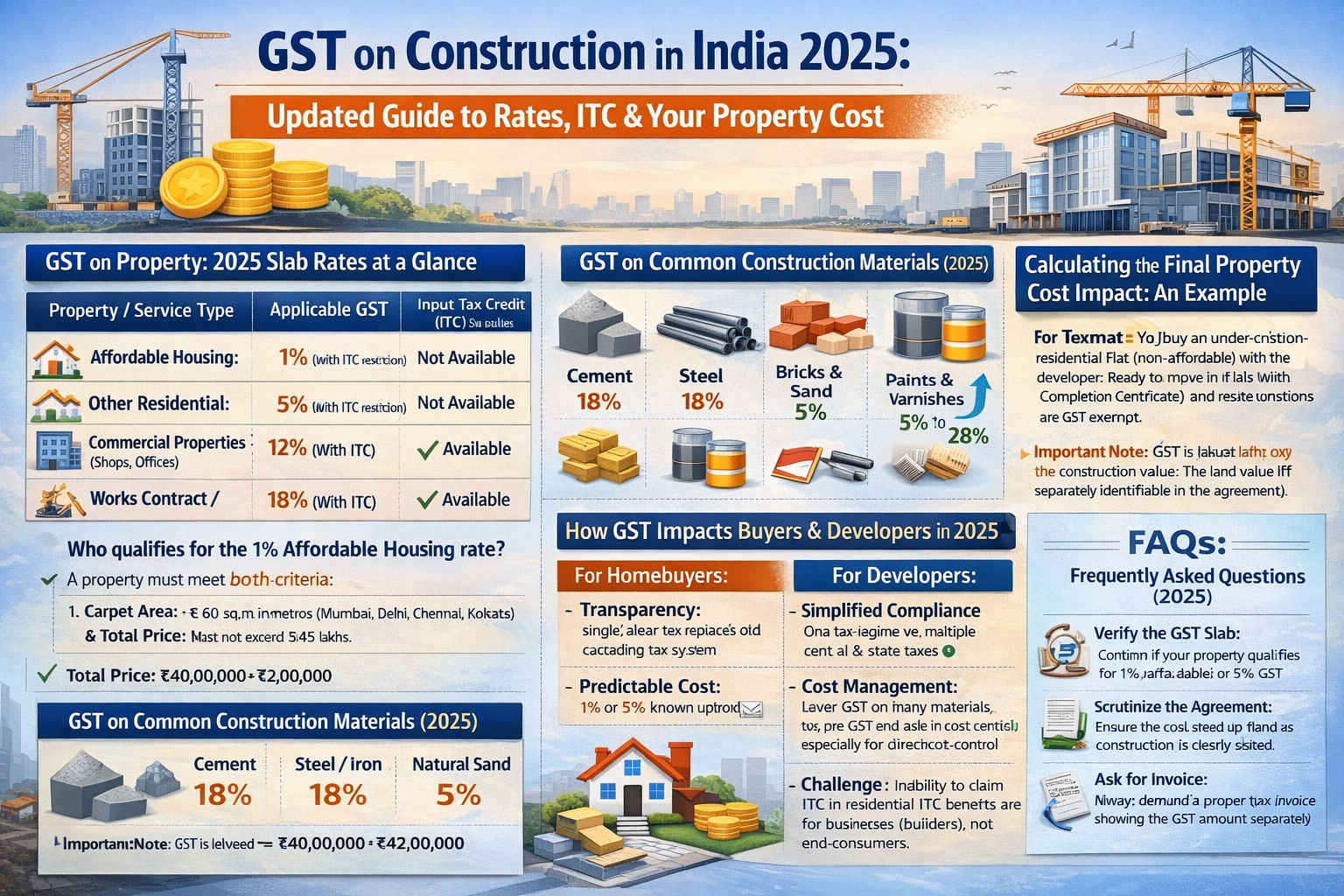
| Property / Service Type | Applicable GST Rate | Input Tax Credit (ITC) for Builder |
|---|---|---|
| Affordable Housing (see definition below) | 1% (with ITC restriction) | Not Available |
| Other Residential Properties (Under-Construction) | 5% (with ITC restriction) | Not Available |
| Commercial Properties (Shops, Offices) | 12% | Available |
| Works Contract / Construction Services | 18% | Available |
Who qualifies for the 1% Affordable Housing rate?
A property must meet both criteria:
- Carpet Area: ≤ 60 sq.m. in metros (Mumbai, Delhi, Chennai, Kolkata, Bengaluru, Hyderabad) OR ≤ 90 sq.m. in non-metros.
- Total Price: Must not exceed ₹45 lakhs.
Key Change: The Input Tax Credit (ITC) Rule Explained
ITC allows businesses to claim credit for taxes paid on inputs. In real estate:
- For Residential (1% & 5% slabs): Builders CANNOT claim ITC on the GST they pay for cement, steel, labour, etc. This is a critical “ITC restriction.”
- For Commercial (12% slab): Builders CAN claim ITC, which helps lower their project costs.
Why does this matter to you? Since builders can’t claim ITC for residential projects, the embedded GST on materials is often baked into the base price you pay. Transparency from your builder on cost breakdown is key.
GST on Common Construction Materials
- Cement: 18%
- Steel, Iron: 18%
- Bricks, Building Blocks, Stones: 5%
- Natural Sand: 5%
- Paints & Varnishes: 28%
- Tiles (Ceramic/Wall): 5% to 28% (varies)
The lower rates on basics like sand and bricks help moderate overall construction costs.
Calculating the Final Property Cost Impact: An Example
Scenario: You buy an under-construction residential flat (non-affordable) with a construction value of ₹40,00,000.
- Applicable GST Rate: 5%
- GST Amount: ₹40,00,000 * 5% = ₹2,00,000
- Total Payable: ₹40,00,000 + ₹2,00,000 = ₹42,00,000
Important Note: GST is levied only on the construction value. The land value (if separately identifiable in the agreement) is exempt.
How GST Impacts Buyers & Developers
For Homebuyers:
- Transparency: A single, clear tax replaces the old cascading tax system.
- Predictable Cost: The final percentage is known upfront (1% or 5%).
- Affordable Push: The 1% slab makes budget homes more viable.
For Developers:
- Simplified Compliance: One tax regime versus multiple central & state taxes.
- Cost Management: Lower GST on many materials (vs. pre-GST era) aids in cost control, especially for affordable projects.
- Challenge: The inability to claim ITC in residential projects requires careful financial planning to avoid cost overruns.
Frequently Asked Questions
Q1. Is GST payable on ready-to-move-in or resale flats?
A: No. GST is only applicable on the sale of under-construction properties from the developer. Ready-to-move-in flats (with Completion Certificate) and resale transactions are GST-exempt.
Q2. Do I pay GST on the land cost?
A: No. If the agreement clearly segregates the land/plot cost and the construction cost, GST applies only to the construction portion.
Q3. Can a homebuyer claim any GST refund?
A: No. The GST paid is a cost to the homebuyer. ITC benefits are for businesses (builders), not end consumers.
Q4. Is there a higher GST for luxury homes?
A: Not directly. Any residential flat that does not meet the “affordable” criteria attracts a standard 5% GST, irrespective of its luxury segment or price.
Smart Checklist for Property Buyers
- Verify the GST Slab: Confirm if your property qualifies for 1% (affordable) or 5% GST.
- Scrutinize the Agreement: Ensure the cost breakup (land vs. construction) is clearly stated.
- Ask for Invoice: Always demand a proper tax invoice showing the GST amount separately.
- Factor it into Your Budget: Include the 1% or 5% GST as an upfront cost when planning your finances and home loan.
Final Insight
The GST framework for real estate aims for simplicity and transparency. As a buyer, your power lies in being informed. Understanding these rules helps you ask the right questions, compare properties effectively, and ensures there are no surprises in your final payment schedule. Always consult with a financial or legal advisor for your specific transaction to make the most confident and cost-effective decision.